How to Choose the Right Battery for a UAV: A Complete Guide
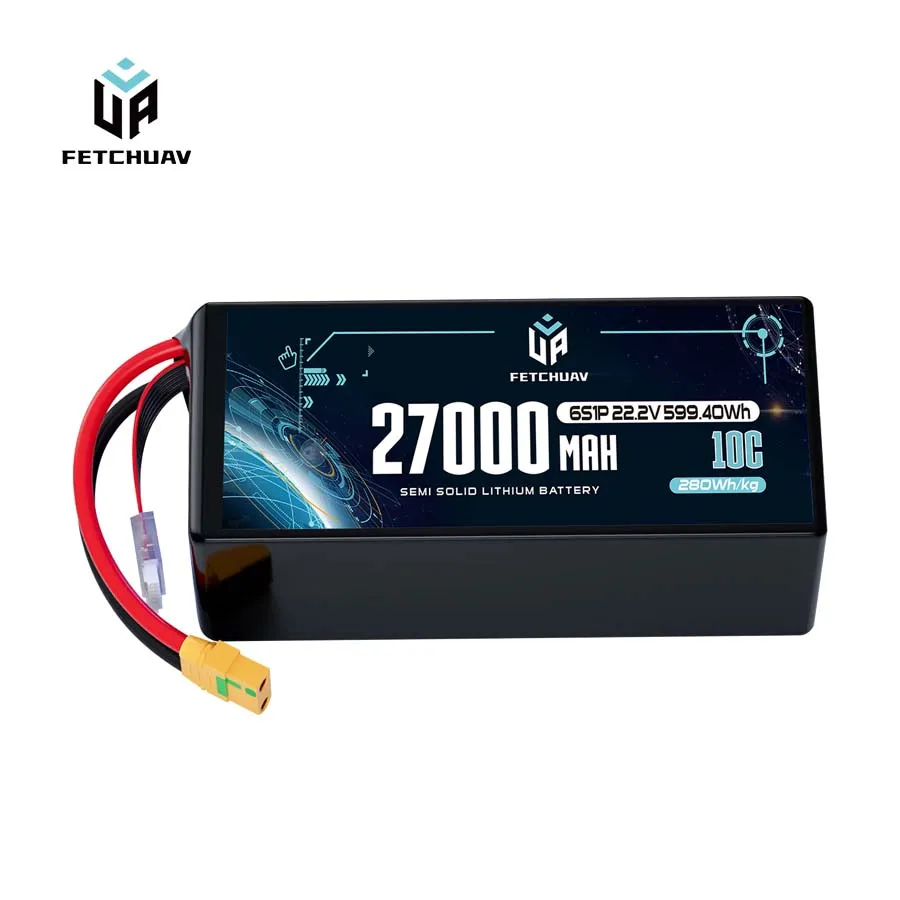
Choosing the right battery is one of the most important decisions when designing or operating an unmanned aerial vehicle (UAV). The battery directly affects flight time, payload capacity, power output, overall weight, and operational reliability.
For industrial drones, VTOL UAVs, agricultural drones, inspection drones, and heavy-lift platforms, the right battery is not simply the battery with the largest capacity. Voltage, capacity, C-rating, energy density, weight, dimensions, and discharge performance all need to be considered together.
This guide explains the key factors to consider when selecting a UAV battery.
1. Understand UAV Battery Voltage
Voltage is one of the first specifications to check when selecting a drone battery.
Many UAV batteries use lithium-polymer (LiPo) cells. A single LiPo cell has a nominal voltage of approximately 3.7V. Batteries are commonly described using an “S” rating, which indicates the number of cells connected in series.
For example:
- 4S = approximately 14.8V
- 6S = approximately 22.2V
- 8S = approximately 29.6V
- 12S = approximately 44.4V
The battery voltage must be compatible with the UAV’s motors, electronic speed controllers (ESCs), power system, and other components.
Using an incorrect voltage can affect system performance and may cause damage to electrical components. Therefore, always check the UAV manufacturer’s recommended voltage range before selecting a battery.
2. Battery Capacity: Ah vs. Wh
Battery capacity is commonly expressed in ampere-hours (Ah) or milliampere-hours (mAh).
For example, a 40Ah battery can theoretically provide 40 amps for one hour under ideal conditions. However, actual flight time depends on the UAV’s power consumption and operating conditions.
Another useful measurement is watt-hours (Wh), which represents the approximate amount of stored energy.
The basic calculation is:
Energy (Wh) = Voltage (V) × Capacity (Ah)
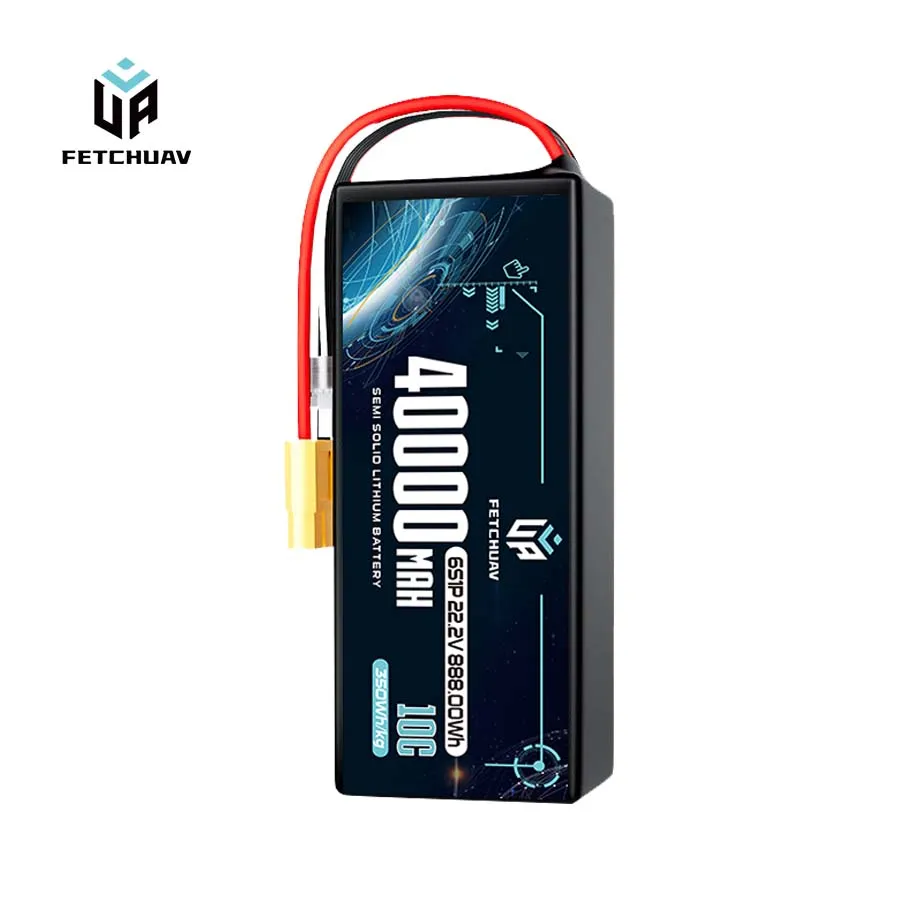
For example, a 22.2V 40Ah battery has approximately:
22.2 × 40 = 888Wh
This makes Wh particularly useful when comparing batteries with different voltage and capacity ratings.
3. What Is C-Rating?
C-rating describes how quickly a battery can deliver current relative to its capacity.
For example, a 40Ah battery rated at 10C theoretically has a maximum continuous discharge capability of:
40Ah × 10C = 400A
In real-world applications, the appropriate C-rating depends on the UAV’s motors, propellers, ESCs, flight profile, and peak power requirements.
A battery with an insufficient discharge capability may experience voltage sag during high-power operation. For heavy-lift UAVs and industrial drones, discharge performance is therefore an important consideration.
4. Why Energy Density Matters for UAVs
Energy density is one of the most important battery characteristics for UAV applications.
It is commonly expressed as Wh/kg and indicates how much energy a battery can store relative to its weight.
A higher energy-density battery can provide more stored energy without increasing battery weight by the same amount.
This is particularly important for UAVs because every additional kilogram carried by the aircraft requires additional lift.
For example, if two batteries provide similar usable energy but one weighs significantly less, the lighter battery may provide more flexibility for payload, flight endurance, or overall aircraft design.
For long-endurance UAVs and heavy-lift platforms, battery energy density should therefore be evaluated together with discharge performance and safety requirements.
5. How Battery Weight Affects Flight Time
Battery capacity alone does not determine flight time.
A larger battery can provide more energy, but it also adds weight. The UAV must generate additional lift to carry that weight, which increases power consumption.
This creates an important balance:
More battery capacity does not always mean proportionally longer flight time.
UAV manufacturers should consider:
- Battery weight
- Battery energy
- Aircraft weight
- Payload
- Motor efficiency
- Propeller configuration
- Flight speed
- Wind conditions
- Average power consumption
For heavy-lift UAVs, finding the right balance between battery capacity and battery weight is especially important.
6. Choosing a Battery for Heavy-Lift UAVs
Heavy-lift drones have different battery requirements from small consumer drones.
A heavy-lift UAV may need to carry cameras, sensors, delivery equipment, agricultural systems, inspection equipment, or other payloads. As payload increases, the aircraft requires more power.
When selecting a battery for a heavy-lift platform, manufacturers should consider:
- Required operating voltage
- Average and peak current
- Required flight endurance
- Battery weight
- Available installation space
- Connector requirements
- Discharge characteristics
- Operating temperature
- Charging requirements
- Transportation and storage conditions
Battery dimensions are also important. A battery may have the required capacity and voltage but still be unsuitable if it cannot fit securely inside the UAV.
7. LiPo Batteries for Industrial UAV Applications
LiPo batteries are widely used in UAV applications because they can provide high power output while maintaining relatively low weight.
They are commonly used in applications where high discharge performance is required, including industrial drones, heavy-lift UAVs, VTOL aircraft, and other high-power platforms.
However, battery selection should always be based on the complete UAV power system rather than a single specification.
For professional applications, manufacturers may also require customized battery dimensions, connectors, wiring, discharge rates, capacity, or communication functions.
8. How to Estimate UAV Flight Time
A simple theoretical calculation can be used to estimate flight time:
Flight Time ≈ Usable Battery Energy ÷ Average Power Consumption
For example, if a UAV has a battery with approximately 888Wh of nominal energy and the aircraft consumes an average of 1,500W:
888Wh ÷ 1,500W ≈ 0.59 hours
This is approximately 35 minutes under simplified conditions.
Actual flight time will normally be lower because of factors such as battery reserve, efficiency losses, wind, payload, temperature, and changes in power consumption during flight.
Flight testing is therefore important when determining the actual endurance of a UAV.
9. Safety and Battery Maintenance
Proper battery handling is essential for UAV operations.
Users should follow the battery manufacturer’s charging, storage, transportation, and operating instructions.
Important practices include:
- Use a compatible charger.
- Inspect batteries before use.
- Avoid using batteries with visible physical damage.
- Monitor battery temperature during operation.
- Store batteries according to manufacturer recommendations.
- Avoid overcharging or excessive discharge.
- Use appropriate packaging and transportation procedures.
For commercial UAV operations, battery management should be included as part of the overall aircraft maintenance program.
10. How to Choose a UAV Battery Supplier
For UAV manufacturers and assembly companies, choosing a battery supplier is not only about price.
A reliable supplier should be able to provide appropriate technical specifications, stable production, quality control, sample testing, and suitable customization options.
Before placing a large order, UAV manufacturers can request:
- Battery specifications
- Cell information
- Discharge test data
- Dimensions and weight
- Connector options
- Sample batteries
- Test reports
- Production capacity
- Customization options
Sample testing is particularly useful because the battery should be evaluated together with the actual UAV power system.
Conclusion
Choosing the right UAV battery requires a balance between voltage, capacity, C-rating, energy density, weight, dimensions, and discharge performance.
For industrial and heavy-lift UAVs, a battery with higher energy density can help manufacturers balance endurance and battery weight. However, the optimal battery depends on the specific aircraft design, power requirements, payload, and operating environment.
By evaluating the complete UAV power system and conducting real-world testing, drone manufacturers and operators can identify a battery configuration that better matches their application.
For UAV manufacturers, VTOL developers, heavy-lift drone companies, and assembly factories, customized battery solutions can also be considered when standard battery specifications do not meet the requirements of a specific aircraft platform.